Slippery Slope Records — Artist

Chase Liberty

Folk & Americana, run through the wringer

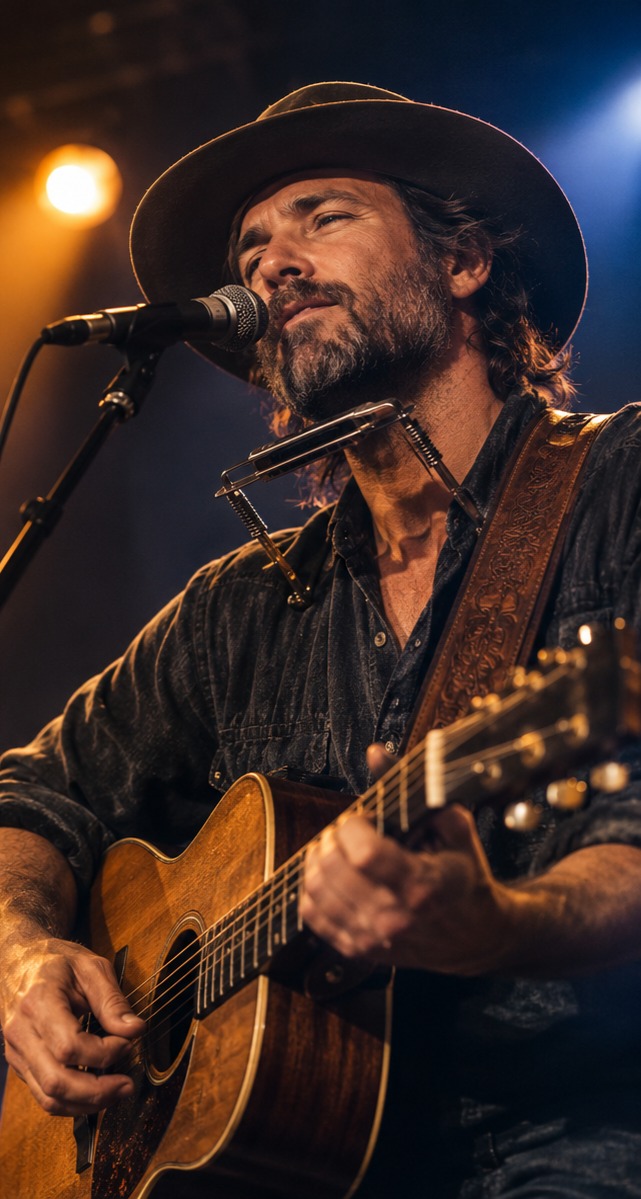
Chase Liberty performing live with an acoustic guitar and harmonica

Chase Liberty was the first artist to come out of this project, built around American folk, the oldest and plainest musical language this country has, because sometimes the plainest language is still the truest way to talk about what's happening in it. Walking Home is straight-ahead folk and Americana. Currency of Fury takes that same folk/country foundation and collides it head-on with dubstep, trap, and glitch, an experiment in how far the sound could stretch before it broke.

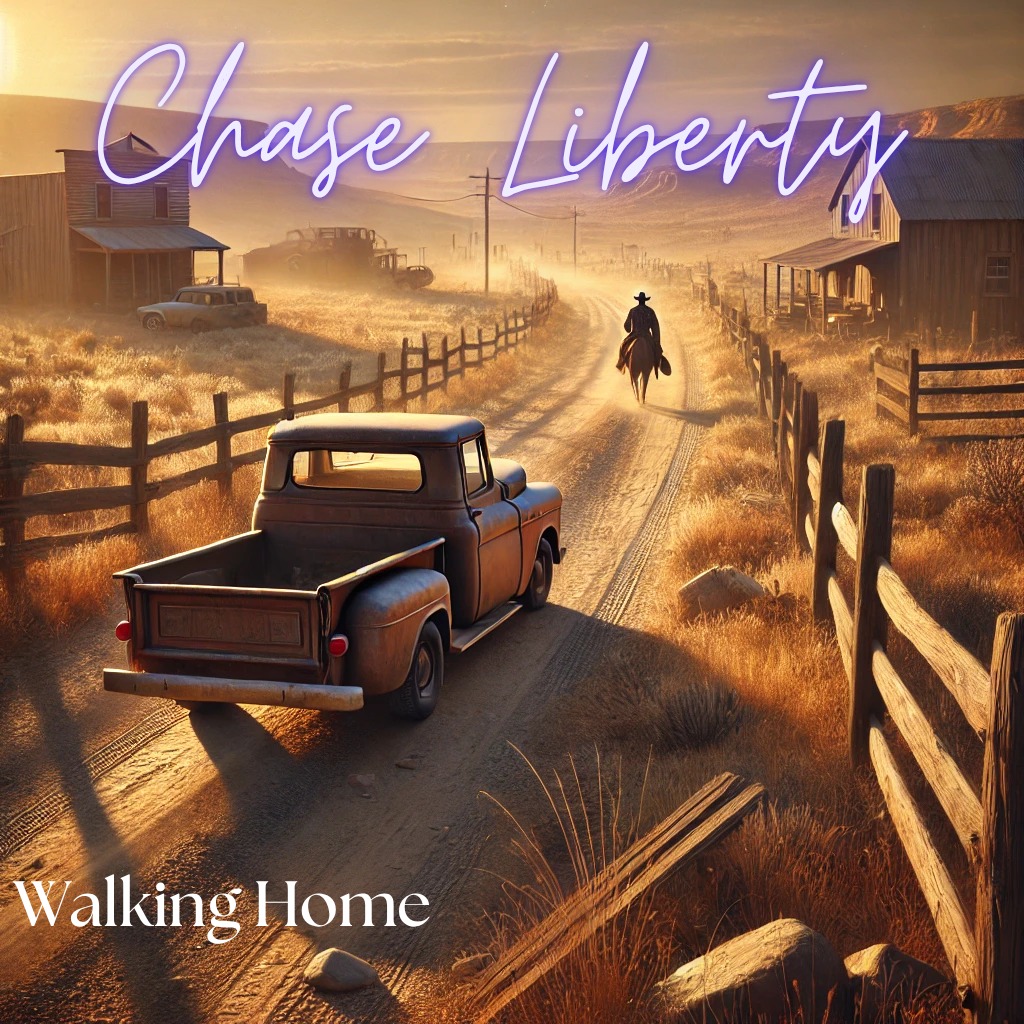
Cover art for Walking Home

Album: Walking Home

September 16, 2025 Spotify

A folk record about home, distance, and the stories we tell each other across borders, generations, and disagreements. It's the album where this whole project found its footing, and where it started.

Spotify

This is the song that started all of it. Before there was a Chase Liberty, before there was a Slippery Slope Records, there was an idea I couldn't shake: that almost all human strife comes down to ink on paper, in one of three forms. Lines drawn on a map, deciding whose home counts as a homeland and whose counts as a war zone. Words printed in a book, used across history to justify almost anything, including the worst of it. And ink pressed onto currency, the thing so many conflicts trace back to in the end, however noble the stated cause. Once I saw the world that way, I couldn't unsee it, and I needed a way to say it out loud.

The song plays that idea out through a father and daughter watching the news together. He's absorbing the weight of it: senators, borders, prayers that don't stop anything. She's just seeing kids under the same sky, drawing stars that don't care about the lines on a map. That contrast is the whole argument of the song, and honestly of this whole project: kids see past the ink long before we teach them not to. “Burn all the ink on paper” isn't really about burning maps, scripture, or money. It's a wish that we could get back to seeing each other the way she does, before anyone drew a line between us.
Coffee's cold on the kitchen table Morning news plays on repeat Another mother lights a candle Where her daughter won't take a seat The senator sends his prayers Like coins tossed in a well While somewhere past the borders Sirens sing through morning's shell It's all just ink on paper The borders that we die for aren't there We bleed in different colors But the blood runs just the same For ink on paper We're burning down in someone else's name There's a boy in Gaza counting stars Through a ceiling that's not there My daughter draws those same stars In a sky we're supposed to share She colors past the boundaries Of the maps hung on her wall Says the lines don't make much sense When the stars shine on us all It's all just ink on paper The money and the holy words we swear We kill for different prophets But the graves look just the same For ink on paper We're dying in some dead man's name She asked me why The world's the way it is I couldn't find the words to say We're dying for a manuscript Burn all the ink on paper Every deed, every creed, every prayer The borders are imaginary The blood is all the same No more ink on paper Maybe then we'd understand Maybe then we'd understand Coffee's cold on the kitchen table Tomorrow's news already written down
Spotify

Where Ink and Paper is about the big abstract forces that divide people, this one is the flip side: the same chain reaction runs the other way too. It's built like a relay: one person's small patience with a stranger in traffic gets passed along, person to person, until it reaches a kid who hasn't grown up around much kindness at all.

I wanted the song to feel almost stubbornly ordinary. Nobody in it does anything heroic, they just choose patience instead of irritation, one decision at a time. That's the point: the same logic that convinces us conflict is inevitable also convinces us that small decency doesn't matter. This song argues the opposite, that kindness compounds exactly the way outrage does, we just don't track it the same way.

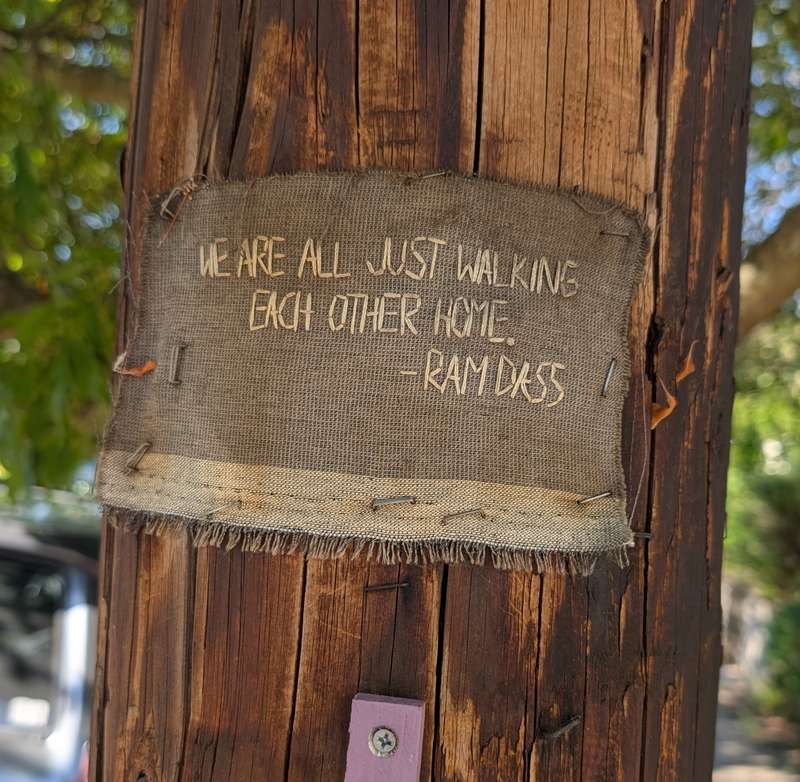
Shortly after finishing this song, I was walking through Portland and came across a piece of folk art stapled to a telephone pole: a scrap of burlap with “We are all just walking each other home” hand-stitched into it, a line from Ram Dass. It echoed the song's chorus back at me almost word for word, and it felt like a small confirmation that I was on the right track. My intent with this song was never abstract. I wanted people to actually think about their actions and choose kindness when they could, because it's not as hard as it seems, and it genuinely makes the world better. I also wanted it to nudge people out of the posture of complaining about the world as if they weren't participants in it, to suggest that if you want to see something different, you're one of the people who gets to build it.

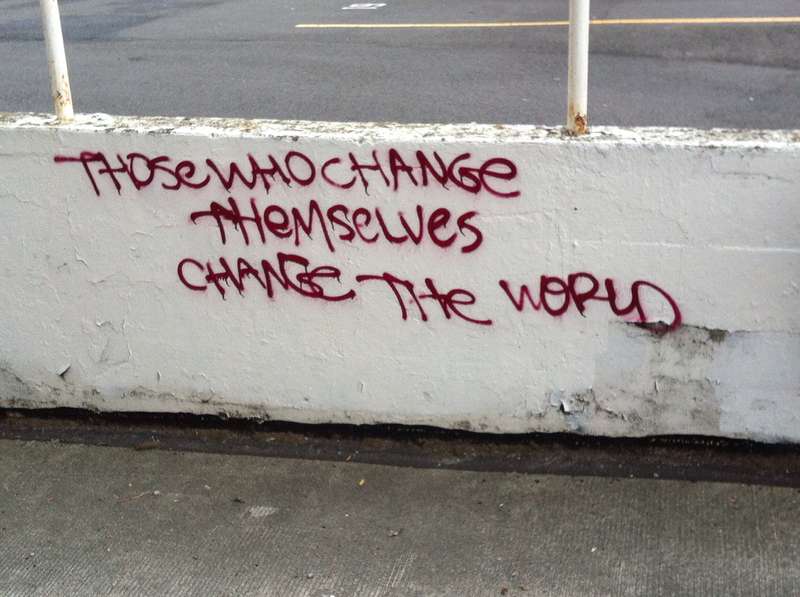
That mindset didn't start with this song, either. Years earlier, in Seattle in 2012, I'd seen another piece of street art spray-painted on a concrete barrier: “Those who change themselves, change the world.” That line planted the seed for everything this song, and honestly this whole project, grew out of: if we want change, we don't get to wait for it. We have to live it first, ourselves, before we can ask it of anyone else.

A scrap of burlap stapled to a telephone pole in Portland: “We are all just walking each other home.” — Ram Dass
Seattle, 2012: “Those who change themselves, change the world.”
Red light, white knuckles, ten minutes running late, Someone cuts me off and now the story's getting old. But I catch her eyes in the mirror, baby crying in the back, Take a breath, wave her through, watch her shoulders un-rack. She makes it to the market, holds the door for someone's gran, Who stops to help a kid reach something with her weathered hands. That kid runs home laughing, shares his prize with the boy next door, Whose dad's been drinking anger, but tonight there's something more— Tonight there's something more. Tonight there's something more. Little lights in the darkness, barely seen, barely known, Tiny revolutions turning, stone by stone by stone. We're all just walking each other, walking each other home, Stone by stone by stone. The father tucks his boy in, thinks about his own dad's rage, Decides to break the pattern, writes a different kind of page. Morning comes, he's calmer, lets his coworker speak first, She's been holding something heavy, and the kindness breaks the curse. Now she's got the strength to volunteer down at the shelter, Where she meets a quiet man who builds from scraps and makes them better— Broken bikes for kids who've never had their own wheels spin, They ride through neighborhoods where hope is wearing thin, But watch them grin. [repeat chorus] It's not the grand gestures that shake the ground beneath, It's the pause before the anger, it's the space between the teeth. It's choosing to see clearly when it's easier to judge, It's the inch we give each other— That becomes the avalanche. [repeat chorus] Red light, white knuckles, ten minutes running late, Someone needs the lane and now...
Spotify

Regina Spektor's original is fragile and hushed, a quiet, almost private telling of one of the Bible's oldest tragic love stories. I liked the idea of flipping that: taking the same devotion and doom and running it through a low, resonant baritone, so it feels less like a secret being whispered and more like a story being carried by someone who's lived through it.

It's a small experiment compared to the rest of the record, but it says something I believe about music generally: that the same words can land completely differently depending on who's telling them, and how. That idea turned out to be more than a passing observation. It's a big part of what led to Amy Davis. If a story can shift depending on whose voice is carrying it, then some stories are worth handing to a voice that isn't mine.

Cover of “Samson”, written and originally performed by Regina Spektor. Lyrics are not reproduced here.
Spotify

This one is built around a calendar, Monday through Sunday, because I wanted it to feel like an actual plan instead of a slogan. Change doesn't happen because someone gives a great speech; it happens because people decide, on a random Tuesday, to trust their neighbor a little more than they did the day before.

“No more armor, no more fear” is about lowering your guard enough to actually do something, instead of staying safely cynical. It's the most hopeful song on Walking Home, and the record needed one. After everything Ink and Paper is carrying, there had to be somewhere to land.

We're growing wild where the walls once stood Each morning breaks the chain Teaching kids to speak the truth The old world turns to rain We're writing songs where the rules were carved With neighbors we don't know Every word's a promise kept Every verse helps us grow We've been living in the shadows We've been sleeping through the fight But we're waking up now No more armor, no more fear We're the change that happens here No more armor, no more fear We're the change that happens here Monday morning, melt the metal down Tuesday, learn to trust Wednesday, we share everything Thursday, adjust or rust Friday brings the rebels singing Saturday, we dance Sunday shows us what we're building When we take a stance I see it in the morning light I feel it in the air Something's shifting, something's different And we put it there Change is not on TV Change is in the streets! [repeat chorus] It's not a dream we're dreaming It's work we're doing now With dirty hands and open hearts We're keeping to our vow No more armor, no more fear We're the change that happens here Same time tomorrow? Always The change is here
Spotify

Not every song here needs to carry the weight of the world. This one's just about the friends who are terrible for you and completely irreplaceable at the same time. Sarah, Mike, and Jimmy aren't real people, but the specific feeling of that kind of night (reckless, loyal, a little embarrassing in hindsight) is very real.

I wanted at least one song on the record to be pure nostalgia without a lesson attached to it. “What's the point of heaven if you can't raise a little hell” is about as close as this project gets to a mission statement for chosen family.

Here we go again! Called up Jimmy, Sarah, Mike—said "meet me where the trouble starts," Twenty minutes later we're all crowded in my beat-up car. Someone's got the bourbon and a plan that's gonna end in tears, But that's exactly why I love these beautiful disasters here. We're the friends your mama warned about, Making memories we'll deny— Trading good behavior For the stories money can't buy. Bad decisions and good friends, that's our religion tonight, Wrong turns and dead ends never felt so right. Burn it bright, burn it clean, We're honey and gasoline! Honey and gasoline! Sarah's dancing on the pool table, Mike just bet his whole paycheck, Jimmy's singing to a cactus, swearing that it loves him back. I'm the designated driver but I'm drunk on all this chaos, Tomorrow we'll blame each other but tonight nobody's at fault. We're a beautiful disaster, A tornado in a dive— But I'd rather crash with these idiots Than play it safe and survive. [repeat chorus] Ten years from now we'll still be laughing 'bout the time we stole that sign, Or when Sarah punched that jukebox just to play "Closing Time." These are the friends who'll bail you out, then jump back in the cell, 'Cause what's the point of heaven if you can't raise a little hell? So here's to bad ideas, And the friends who make them worse— [repeat chorus]
Spotify

This is the one with the anniversary card story. Gagliardi's original plays under an unexpectedly kinetic action scene in The Man from U.N.C.L.E. remake, and that contrast, a tender Italian ballad soundtracking chaos, stuck with me for years. My wife loved the song, and the following year, for our anniversary, I decided to translate it onto her card, very earnestly, line by line.

I got about two-thirds of the way through before realizing, a little too late, that it's actually a breakup song. I had to improvise an ending fast. It's a funny memory now, but it's also why this song means something different to me than it probably meant to Gagliardi. It became a small story about good intentions outrunning attention to detail, which felt worth including here even without reproducing the lyrics themselves.

Cover/translation of “Che Vuole Questa Musica Stasera”, written and originally performed by Peppino Gagliardi. Lyrics are not reproduced here.
Spotify

This song is about watching yourself repeat a pattern in real time and not being able to stop it: chasing someone who isn't good for you, down actual highways (Tucson, Phoenix, Bakersfield) and down a much older road that started with your grandfather and your father before you.

“My grandfather built fences, my father tore them down” is the emotional center of it: the idea that we inherit our relationship patterns the same way we inherit anything else in a family, often without ever choosing to.

She moves like smoke through a border town, Speaks in tongues I'll never learn. Every goodbye's just a turnaround, Every bridge another one to burn. Met her singing for gas money, Voice like gravel and aged whiskey neat. Now I'm paying for what was never free— Chasing shadows down an empty street. It's gravity and rye, gravity and rye, Pulling me under, burning me dry. Round and round we go, can't break the tie, Dancing in circles to gravity and rye. Tucson, Phoenix, then Bakersfield, Following taillights through cigarette haze. Heart like a wound that won't heal, Counting down these numbered days. [repeat chorus] My grandfather built fences, My father tore them down. And here I am at thirty-seven, Still chasing what can't be found.
Spotify

Marvin Gaye's “What's Going On” is one of the most enduring protest songs ever written, and I wanted to bring that same question into this moment, specifically in response to watching federal agents disappear entire families, or parts of families, during immigration enforcement actions.

Translating it into Spanish was the point, not incidental to it. I wanted to push back on the instinct some people have to tune out a story the moment it's not being told in English, as though the language it's told in has anything to do with whether it matters.

Cover/translation of “What's Going On”, written and originally performed by Marvin Gaye. Lyrics are not reproduced here.
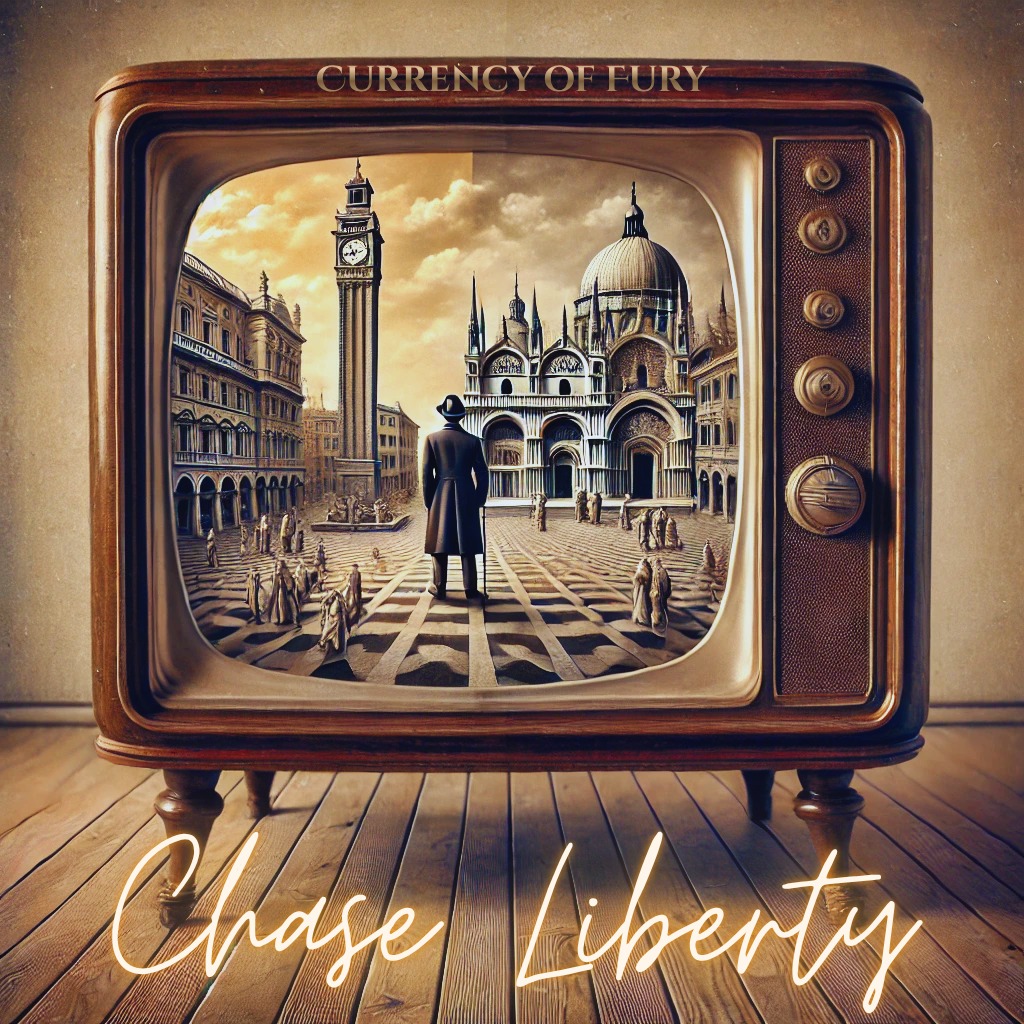
Cover art for Currency of Fury

Album: Currency of Fury

October 31, 2025 Spotify

The experiment: take the same folk/country foundation from Walking Home and detonate it with dubstep, trap, and glitch production. Where Walking Home is measured, Currency of Fury is anxious, loud, and online, a record about the economy of outrage we all trade in now.

The sound was built to argue the same point the lyrics do. Underneath the trap hi-hats and glitch textures, there's still an acoustic guitar and a weathered, lived-in baritone carrying every song. Nothing about the folk core gets replaced, it just gets pulled into a late-night, soul-and-sax groove it wouldn't have found on its own. A crooning saxophone shows up throughout the record as the human counterweight to all that electronic noise. The idea was to make something that still feels intimate and honest even while it's danceable and loud, proof, in the production itself, that you can open yourself to something new without losing what made you real in the first place.

Spotify

This is the album's thesis, and the angriest song on it. The idea started with a simple observation about how influencers actually make money: engagement is what gets paid, and people engage with divisive content far more readily than they engage with anything hopeful. So the incentives are backwards. The platforms and the people who work them have figured out that manufacturing outrage, even outrage nobody actually believes, is more profitable than telling the truth.

I wanted the song to hold up a mirror to both sides of that transaction: the influencer posting something divisive they don't even believe because it performs well, and the audience that keeps rewarding it with clicks and shares. Both sides call the result a “ruined society,” but both sides built it, one post and one engagement at a time. “I'm the dealer, you're the user” is the line that pins that down. Nobody in this song gets to stand outside the system and point fingers, the narrator included. We got ourselves here, which means we're also the only ones who can change where it's headed.

Posted something I don't believe at 3am Watch the numbers climb like smoke from where we've been Every comment is some gasoline, every share a little flame I'm just giving what you're craving, we're both playing the same game You say I'm the problem but you still hit refresh Addicted to the outrage that I manifest Some folks just like to watch the world burn Especially if we get paid Making money off the fear we've made Strike the match, fan the flames, sell the ashes back again I'm the dealer, you're the user In this currency of fury that we trade Scrolling through catastrophe with a cigarette in bed Can't look away from trainwrecks that total strangers spread I know I'm feeding monsters when I stop to type my rage But the anger feels like purpose on this burning digital stage They say we're the problem but they keep serving hate We're all arsonists pretending that it's fate [repeat chorus] "I'm just a mirror, baby" "We're just human nature" "Point the finger elsewhere while we burn up every acre" "But the kids are watching us trade their future for paper" Tomorrow I'll post something kind, tomorrow you'll scroll past We built this bonfire together, now it's burning through us fast The currency of fury is the only coin that pays We're all arsonists and audience— Setting fire to our days [repeat chorus x3]
Spotify

After the title track diagnoses the problem, this one asks the actual question underneath it: what would it personally take for you to choose kindness over anger, love over hate, real change over just going along with the patterns already around you? I wanted it to stay socially conscious and universal without ever tipping into preachy, religious, or just plain depressing. The whole idea rests on something hopeful: that individual change is how a wider change actually starts. That's also why the hook itself, “what would it take?”, doesn't get overused. It only shows up where it needs to, so it stays a real question instead of becoming a slogan people stop hearing.

The arrangement is built to make the same argument the lyrics do. It opens with an extended acoustic intro, no rush into the vocal, just space to sit with the question before answering it, and only gradually lets the drum-and-bass groove, restrained sub-bass, and glitch textures in underneath. A soulful, crooning saxophone runs through it as a human counter-melody to all that electronic modernity, building to its own solo before the final chorus brings the folk and electronic elements together at full strength. By the outro, the electronics strip back out again, leaving just acoustic guitar and sax: a weathered folk voice that stepped into something new and came back out the other side still itself.

What would it take to open your hand? How long until you finally stand? Against the tide of anger and fear To bring a little kindness here What would it take what would it take? To trade love for the hate we make? Isn't it time to break the chain And never go back again? When will we learn to soften our voice? Could you ever make that choice? The world is burning but we can begin The smallest spark can turn the wind One by one the change will rise In broken hearts in open eyes What would it mean for me and you? Maybe it starts with something true [repeat chorus x2]
Spotify

This one is built entirely out of sensation: taste, smell, touch, sound. The idea underneath it isn't really an argument, it's a feeling: a kind of collective numbness everyone seems to be carrying at once without anyone saying so out loud. There are undertones of class and inequality running through it, but they stay implied rather than preached. I wanted this to read as something anyone could feel pressing on them, not a song aimed at one city or one specific grievance. The hook, “can you feel it, feel it, feel it now?”, is meant to be simple enough to hum and honest enough to actually mean something when it lands.

The arrangement is where the song does a lot of its talking. It pulls in West and North African polyrhythms (djembe, bendir, talking drum, oud) against trap 808s and heavy dub bass drops, with the vocal kept dry and unprocessed the whole way through, like a single steady voice inside all that motion. The song keeps stopping and restarting completely, shifting tempo and feel each time, building to a final passage where three different rhythms run at once in controlled, layered chaos, which is really the point. That's what it feels like to be one person trying to breathe inside something much bigger than yourself.

Taste the metal in the water, copper pennies on the tongue Everybody's stories written but nobody's songs get sung Static in the air between us, signals we don't receive We're all holding our breath together, forgot how to believe Can you feel it, feel it, feel it now? We're all falling but we don't know how Can you feel it, feel it, feel it now? We're all calling but there's no sound Feel the weight, feel the weight Of what we don't say Invisible chains, invisible chains Dressed up like a normal day Feel the tension in the wind, unspoken and divine Everybody knows the truth but toes the same old line Collective hum of all our hungers drowning out the birds Trading silence for compliance, can't afford the words [repeat chorus] Skin remembers what the mind forgets Every door closed is a small regret Taste the salt of borrowed time Feel the rhythm of the breadline Hidden in plain sight, you bet We dance-dance-dance in place While the ground-ground-ground gets erased Collective unconscious, collecting dust In the violence of the peaceful, we trust Feel the pulse beneath our feet, ancient drums in the earth See the colors bleeding at the edges of our worth Breathe in deep that strange perfume, progress in our lungs We're all climbing broken ladders missing half the rungs [repeat chorus] Still breathing.. still breathing..
Spotify

This one started as an English reinterpretation of “Bésame Mucho,” not a translation, but a song built from the same DNA: someone asking to be kissed like it's the last time, over and over, unable to get enough. Sung as an elderly man remembering a wife who's died, it's heavy with regret for all the kisses he didn't take while he had the chance, one kiss, or ten, the way Shakespeare put it in Venus and Adonis: “Ten kisses short as one, one long as twenty.” I wanted it to keep that familiar “kiss me many times” feeling everyone half-recognizes, but stripped of anything poetic or old-fashioned. Plain and true instead, with each different kind of kiss (morning, goodbye, the altar, the rain) carrying its own specific memory.

The evolution that actually made the song work was realizing this isn't just grief. It's grief moving through dementia. His voice cracks when a memory is faint and far away, then brightens when it becomes vivid and “real” again in a dementia-induced reliving, so the whole song oscillates between confusion and sudden clarity. The gut-punch running underneath all of it is that he can never quite reach her name: “it starts with M... or was it—,” “Muh... Mar... I can't find your name,” ending on “Your name... I had your name.” I set the marriage and memories deliberately in the 2000s and 2010s (a wedding in 2004, about twenty-one years together) rather than anywhere nostalgic or old-timey, because this needed to feel like it could be happening to someone right now, not like a period piece.

The bass carries as much of the story as the lyrics do. It's heavy dub-trap at a slow, aching tempo, with the folk guitar reduced to an undertone that flickers in and out between crushing sub-bass drops that hit unpredictably, felt more than heard, arriving the way memory and confusion actually do, in waves you can't schedule. His voice needed to sound genuinely old, not just sad: frail, trembling, close-mic'd, sitting inside the bass rather than over it. The song opens on a pure sub-bass drone, builds through those drops, breaks down completely at the peak of his confusion, then strips to near-silence for one last moment of clarity before the bass swallows everything and the song ends on a whisper.

There's a woman in the doorway no wait She's gone again Just the curtains breathing shadows where her smile had been I know her name I know her face it's somewhere in the grey My l— My love my sweet love Sunday morning kisses coffee on your breath Lipstick on my collar laughing at the mess Goodbye kisses at the door that lasted half the day How many kisses did I waste rushing away? Kiss me through the shadows kiss me through the years Kiss me like that Tuesday when you tasted all my fears Kiss me till these empty rooms remember love again Kiss me 'til I remember how to breathe your name your name Slow dancing in the kitchen 2003 no '13? Your dress was yellow— or blue— or the color of the sea Those stolen kisses in the rain we let the whole world go I see you clear as daylight then you fade like melting snow Wait— you're in the garden No that's just the morning light You kissed me at the altar! You kissed me back to life! But where are you this morning? They say you've been gone ten years Muh Mar I can't find your name Kiss me Kiss me through the shadows kiss me through the veil Kiss me like our first time when my mind began to fail Kiss me till these empty rooms remember love again Kiss me 'til I find you in this fog of joy and pain I trace your name in window fog then lose myself Your perfume's just the lavender the nurse keeps on the shelf But wait— there you are love in that sea green dress you wore Come here darling sweetheart, just once more just once more Your name I had your name
Spotify

This one comes from a real, recurring ache: nurturing a friendship that's going well, and then watching the other person quietly drift, with no fallout and no explanation, just the fade. The “yeah, we should totally hang out” that never turns into an actual plan. But the song isn't really about missing any one person. It's about the deeper, harder question underneath the loneliness: what is it about me that keeps prompting this same pattern? I wanted the apology and the self-questioning in the lyrics to stay dignified rather than pathetic, so the “what if it's me?” wondering stays open and a little wry instead of self-pitying, recognizable to anyone who's had this happen, without tipping into anything that sounds like begging. And it stays unresolved on purpose, because the real version of this experience never resolves either. There's no clean ending, no answer, just the door still open.

The whole song runs on one contrast: a danceable body carrying an aching heart. It's built on house energy (upbeat, relentless, 128 BPM) under lyrics that hurt, the specific feeling of dancing alone in a club after everyone else has already gone home. The acoustic guitar stays present as a folk ghost underneath the electronic production, buried deeper and deeper as the song intensifies, and the baritone vocal stays close-mic'd and human against the machine groove on purpose. The vulnerability is supposed to cut against the beat, not blend into it. “Used to be easy” repeats like a near-mantra that gets more desperate every time it comes back around while the beat never once lets up, and the production gets darker as it goes: heavier sub-bass, minor-key stabs, drops where the beat cuts out completely to reverb tails before slamming back in, so the loneliness gets some teeth instead of just sounding sad.

First Tuesday of the month, you'd text around noon, "Same spot, same time?" and I'd always make room. We'd talk about nothing, laugh about everything, Calendar ritual, that comfortable swing. Then the texts got fewer, responses took days, "Yeah, we should totally"—but it fades, it fades... Used to be easy, used to be easy, Now I'm scrolling through the silence, feeling heavy. Used to be easy, used to be easy, Tell me what I did—or just tell me something, please. Heard you're doing great from friends we both still know, Meanwhile your words "we should catch up" echoes with no show. If I crossed a line I didn't even see, I'll apologize for ghosts you won't name to me. I keep the door open, but you walked past the frame, Left me wondering if I'm the pattern or I'm just the blame... Used to be easy, used to be easy, Now I'm moving through the memories. Used to be easy, used to be easy, Was it me, was it you, or just entropy? Maybe I talk too much, or not enough about the right things. Maybe I'm the friend you outgrew, the one you meant to call but... Used to be easy, used to be easy, Now I'm searching for the moment it stopped being. Used to be easy, used to be easy, If you ever figure it out, would you let me know? Used to be easy (so easy), used to be easy (so easy), I'm still here if you remember how we used to be... Used to be... easy...
Spotify

This one started as a mood before it was ever a song: a crossbreed of the hypnotic, trance-like pulse of Enigma's “Sadeness” and the grinding industrial menace of Nine Inch Nails' “Closer,” carried by a folk baritone instead of either of their usual voices. The mandate was for it to work loud in a goth or industrial club and still land with the edgier end of a folk crowd: overtly passionate, but never awkward, with the folk identity showing up as atmosphere rather than an acoustic guitar out front. The whole thing is meant to sit more on the music than the words, with the voice doing most of the seducing.

The real craft decision here was restraint. An early draft named things directly (ropes, blindfolds, submission) and it was too much, too literal, in every verse. The fix was to allude and never state: let “ritual” in the chorus carry all the ambiguity, and let the listener fill in their own version of what's happening rather than handing them someone else's. The song also moved from watching a scene to being inside one. The first pass described a dance floor from the outside, and the correction was to make it feel like an intimate, private moment despite however loud or crowded the room actually is, the same trick “Sadeness” pulls off. Everything else follows from that: a slow 95 BPM pulse built to feel like a heartbeat, reversed and chopped acoustic fragments standing in for literal folk instrumentation, breathing used as a percussion element, and a voice that ranges from a whisper right up against the mic to a controlled growl: dark, physical, and never once spelling out what it's actually about.

There's a fever in the quiet Something shifting in the air You can fight it or invite it I already know you dare Moving closer, moving slow Teaching time a different speed Everything you think you know Becomes everything you need This slow burn between us Taking all the oxygen No return between us Let the ritual begin ..begin Your reflection in the mirror Shows you someone you don't know Every second drawing nearer To the places we can go Gravity is just a word When you're floating in my space Every whisper that you heard Is written on your face [repeat chorus] Count the seconds, count the cost Some lines can't be uncrossed Close your eyes and trust the fall You were never in control at all This slow burn between us Burning Taking all the oxygen All of it No return between us No return Let the ritual begin Slow.. slow burn..
Spotify

This is a tongue-in-cheek protest song about the gap between how American cities get described from a podium (“cesspools,” “hellholes,” “rat-infested,” “worse than Afghanistan”) and the ordinary, thriving reality of the people who actually live in them. The goal was never to score cheap shots at anyone who believes that rhetoric; it was to get a listener who's only ever heard one side to quietly start questioning it themselves. Disarm, don't dunk. Every verse pairs an actual quote, kept in quotation marks so it's clear it's real, against a small, specific, warm counter-image pulled from real life: Baltimore's “disgusting mess” against a cousin teaching kids to read three blocks away, Chicago's “worse than Afghanistan” against a grandmother who raised eight kids peacefully on 63rd Street, Portland's “out of control” against a barista who drew a heart in the foam and wished me a nice December. No hiding behind “American cities” in general. Naming the actual cities and the actual quotes is what makes the rebuttal land instead of reading like an opinion.

The chorus went through real work to get right. An early “hell of a nice day in the hellhole” version was catchy but too cute; it became “Welcome to the wasteland, we're doing fine,” answered by “(They're selling fear, we're living here).” That parenthetical carries the entire thesis in four words. The closing line, “These streets are ours, these streets are ours,” is the point underneath the joke: these places belong to the people living in them, not to whoever's describing them from a studio.

Musically, this one needed a hard correction. Early versions came out as slow, dragging, gospel-funeral-paced, and made the vocal sound lazy instead of confident, so the tempo came up and the whole identity got reframed: this is a folk storyteller experimenting with dub and trap, not a trap artist doing folk. The voice leads, every word has to stay intelligible, and the 808s and dub delays sit behind the story as seasoning, never the main dish. It opens with about thirty seconds of real city field recordings before a single instrument comes in, breaks down to just bass and voice for a half-spoken bridge that states the song's thesis outright, and ends by handing the question straight to the listener: “So next time they tell you we're living in hell... ask yourself who profits from the story they tell.”

Baltimore's a "disgusting mess," that's what they said today, But my cousin's teaching kids to read just three blocks away. Chicago's "worse than Afghanistan"—man, that's news to me, My neighbor's grandma raised eight kids on 63rd Street peacefully. Welcome to the wasteland, we're doing fine (They're selling fear, we're living here) Welcome to the wasteland, yours and mine (They're selling fear, we're living here) These streets are ours, these streets are ours Welcome to the wasteland, we're doing fine Portland's "out of control," troops deployed in September, But the barista drew a heart in my foam, said "have a nice December." D.C. needs "rescuing from squalor"—brother, have you been? The monuments still standing, democracy still breathing in. [repeat chorus] "Rotting," "blood-soaked," "paradise lost"— Count the fear, calculate the cost. When you need an enemy to sell, Just call someone's hometown hell. But we're here making art, raising kids, living life, While you're on TV sharpening the knife. Memphis is "deeply troubled," Aurora's a "war zone" too, Oakland's on the hit list—tell me, what'd they do? Built communities, fed families, kept culture alive— Guess that's what happens when cities actually thrive. [repeat chorus] Yeah, come visit the cesspool Real nice people in this war zone Best art in the ruins Living good in the wasteland So next time they tell you we're living in hell... Ask yourself who profits from the story they tell. Welcome to the wasteland... we're doing fine...