Slippery Slope Records — Artist

Amy Davis

Smoky lounge jazz, built for the ones who go unseen

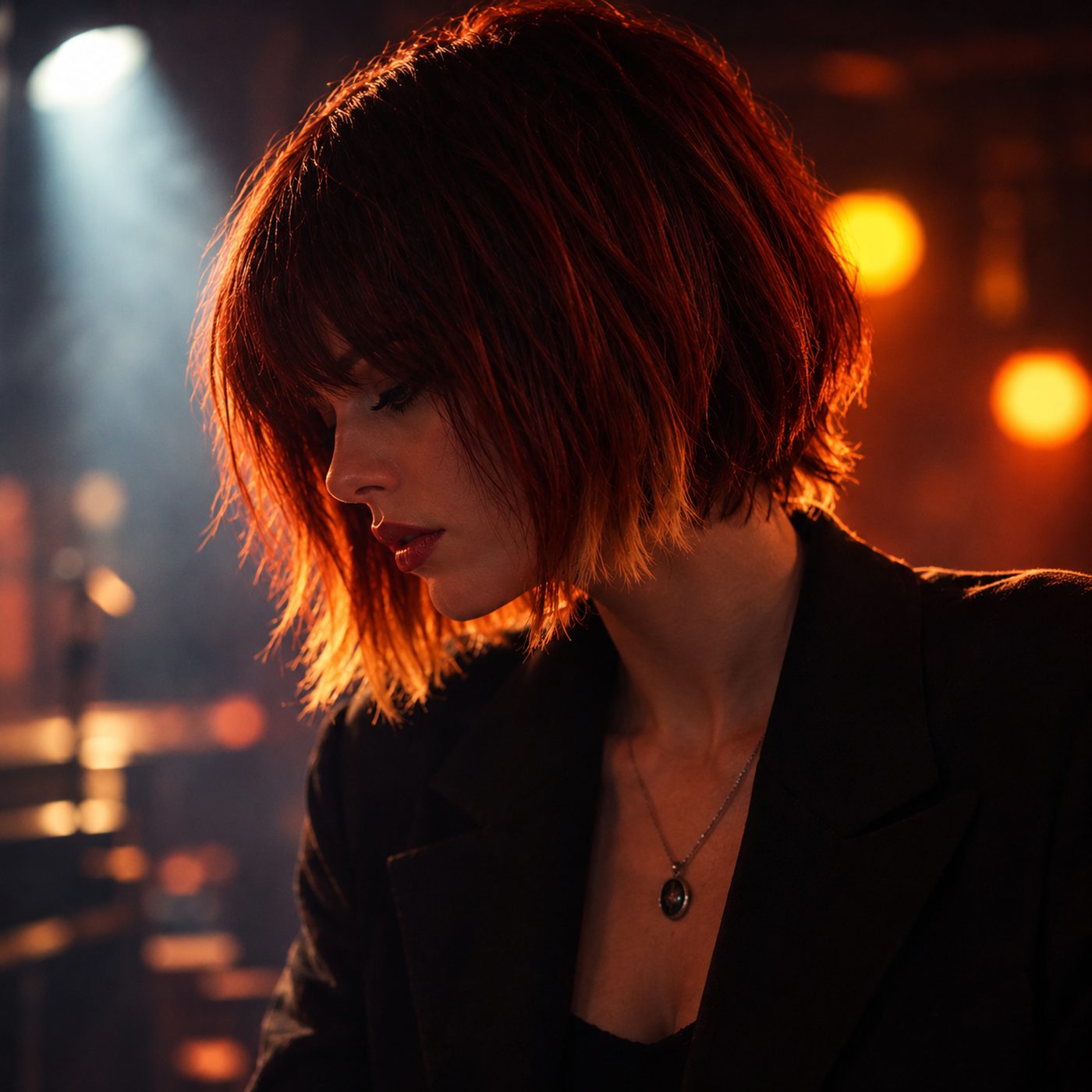
Amy Davis, backlit in red and blue stage light

Amy Davis was the first female artist to come out of this project, and the one I was most careful about. Her name is a deliberate combination of two women: Amy Winehouse, a massive vocal influence and a talent I feel was exploited and cut short far too soon, and Angela Davis, the activist and scholar whose political voice took shape in the 1960s and who has spent a lifetime speaking to the struggles of the marginalized. The goal with this project was to help resonate with and support women facing obstacles that, frankly, go largely unnoticed by people like me: middle-aged white men. Her sound was meant to be smoky lounge jazz, built around a self-imposed challenge to keep to just three instruments: snare drum, guitar, and Hammond B3 organ. The AI had other plans, but the intent behind every song stayed the same.

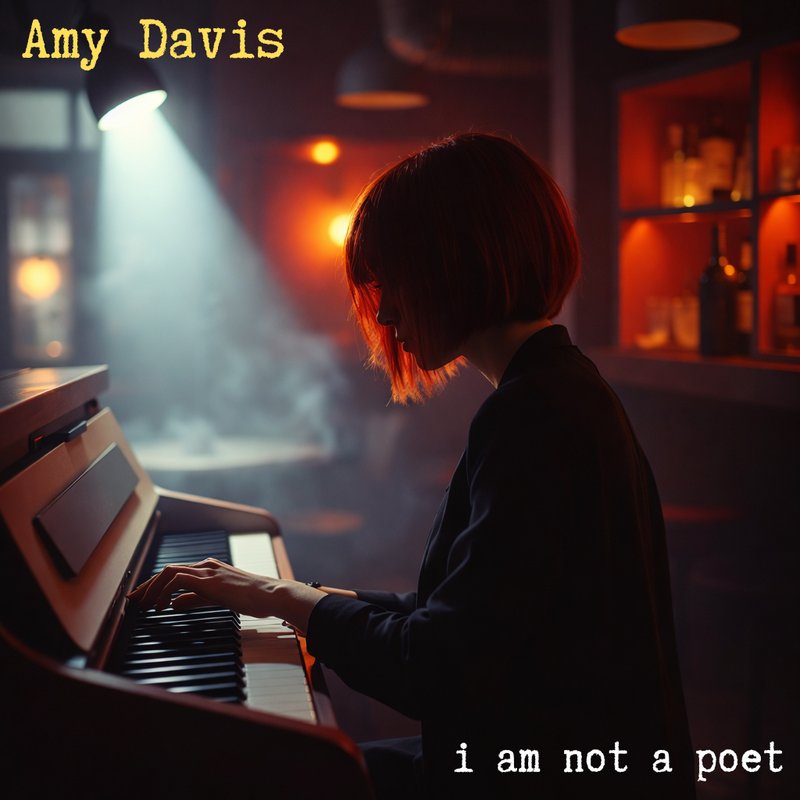
Cover art for i am not a poet

Album: i am not a poet

January 22, 2026

The release date is deliberate. January 22 is the anniversary of Roe v. Wade, and putting this album out on that day felt like the right way to mark it — a record built for women facing obstacles that go largely unnoticed, arriving on the date this country first reckoned with one of the biggest. That's most direct on "What Was Never Yours," a track written as an intergenerational address about bodily autonomy, but it's the thread running under the whole album, not just the one song.

Spotify

This song is written for Renée Nicole Good.

On January 7, 2026, Renée, a 37-year-old writer, poet, and mother of three from Colorado Springs living in Minneapolis, was fatally shot by an ICE agent during an immigration enforcement stop in the city's Central neighborhood. Multiple independent video analyses, including from the New York Times and Washington Post, contradicted the official account of the shooting. Her death sparked nationwide protests and renewed scrutiny of immigration enforcement tactics.

This song isn't really a political statement, even though it comes out of a deeply political moment. What stayed with me, reading about her afterward, was that by every account her instinct wasn't rage. It was grace. That's what this song is actually about: a tribute to a woman who spoke up for people who often go unseen, written by someone who never met her but couldn't stop thinking about her, or stop thinking about how much better a response she gave the world than the one it gave her.
Dear Renée I never got to know you But I read about the words you wrote You gave your voice to strangers The ones we never see Until you spoke You drove north to start again Your boy drawing on the glass The art that children make Before they learn what lasts Dear Renée With your whole world in that car And nothing in your hands You spoke the only language That fear won't understand You said "I am not mad at you" You believed that we're here To keep each other whole They brought their fear and guns But couldn't touch your soul Dear Renée Your babies heard you say That grace is how we fight You left your voice inside them It carries through the night You said "I am not mad at you" You wrote with words like knives For lives nobody saw And in your final breath You gave us something more Dear Renée The ones you spoke for Now speak for you The ones who know your name Know what to do We'll say "I am not mad at you" I am not mad at you I am not mad at you Dear Renée Dear Renée I am not mad at you Dear Renée..
Spotify

This is a direct homage to Amy Winehouse, not an imitation of her, but an imagining: if she had one more song to write, from wherever clarity finally reaches you, what would matter most? Her own words are on record that she felt she was put here to be a wife and a mother, that she wanted two or three children, and reporting at the time of her death said she'd been in the process of trying to adopt a girl from St. Lucia. What struck me most, reading into her story, was that the tragedy was never recklessness or not knowing. She'd gotten clean from heroin and crack, she was counting her sober days, people close to her said she was close to making it through. The machine had already closed the doors before she understood the cost of walking through them.

The song is written as Amy speaking directly to that daughter she never had, a presence she'd already named, in her own mind, Lucky. Not advice to her younger self, and not regret spiraling. Something closer to clear-eyed longing, a woman finally sober in a way she never got to be while she was alive, reaching toward someone who was always waiting on the other side of a door she signed away before she knew it was closing. “They put a pen in my hand before I knew what doors would close” is where the industry itself lives in the song: contracts, cameras, ink, named plainly, without needing to explain further. There's no resolution at the end, on purpose. Life and death don't offer one. Neither does Lucky.

I can't see your face But I feel you somewhere On a road I never walked Would you hum before you spoke? Would you have my stubborn streak? There's a park, an afternoon Playing hide and seek I would have called you Lucky And you would have been On a quieter road Waiting to begin Saturday morning Your hair in my hands Your small voice under mine No cameras Just the radio on And all this time There's a kitchen, candle flame Singing songs without my name [repeat chorus] They put a pen in my hand Before I knew what doors would close You were waiting On the other side And I didn't know [repeat chorus]
Spotify

A direct song about bodily autonomy and reproductive rights, written as an intergenerational address: mothers, daughters, and grandmothers all carrying the same fight forward, generation after generation, whether or not the law agrees it's theirs to carry.

“What was never yours won't cross this line, what was never yours was always mine” is written as a refusal, aimed at anyone (a legislature, a court, a man) who thinks a woman's body is a subject open for debate.

January carved a promise in the law, Ink that said these hands were finally ours. Daughters walking where their mothers bled, Carrying the words their grandmothers said. You can hold your gavels, stake your claim, Take our choice to hide your shame— But we won't play your losing game. My body was never your debate, Never your dominion, never your estate. You can lock the doors, legalize the hate— What was never yours won't cross this line. What was never yours was always mine. Little girls are watching what we do, Learning if their bodies belong to them or you. Every mother holds a daughter's hand, Whispers: you were born to make your stand. You can build your fences, draw your lines, Wrap your fear in righteous signs— But there's a fire you can't confine… [repeat chorus] To every daughter told to sit and wait, To every woman boxed inside their fate— Your hands are free, your voice is strong, Your body knows where it belongs— And to the men who've had it wrong: Keep your hands off. Move along. [repeat chorus] …always mine.
Spotify

The seed of this one was a single sentence someone said to me: “I want to be so blessed that I can be a blessing to others.” Strip that down to its plain, non-religious core and you've got the whole song: ambition as a form of love, not greed. The narrator's entire drive toward “making it” is really a drive to repay and uplift the people who carried her when she had nothing. She keeps a running mental ledger of it: borrowed sugar, a ride to work, a “don't worry about it, love.” “This greed ain't greed, it's group therapy, where the only cure is spreading out the profit” is the line where the whole reframe lands. I wanted her hopeful and hungry, not wounded. This isn't another lament, it's a woman driven by how much she wants to give back once she's able to.

Amy Davis's sound is built around a real constraint: just Hammond B3 organ, twelve-string guitar, and a single snare, nowhere to hide behind a bigger arrangement. This song leans into that fully: dive-bar intimacy that swells and recedes rather than climbs in a straight line, with the quietest moment (a half-spoken confession over one sustained organ drone) carrying more weight than the loudest. It's the most purely soul-jazz track on the record, built to feel like a late-night, after-hours room rather than anything churchy. Every ounce of gospel instinct was deliberately kept out of it, so what's left is just the voice and the debt she's trying to pay down.

Got a habit of keeping score in reverse, Every blessing I catch feels borrowed first. These empty hands shake with ambition, Building castles from eviction notes and wishin'. My grandmother's rings sit in the pawn shop window, But I walk past them daily, let that hunger grow. 'Cause I'm saving up for something I can't name yet, Like freedom with a forwarding address. They say I'm selfish, chasing paper dreams, But they don't see the faces in my schemes. When my ship comes in, I'm buying back the neighborhood, Every IOU I've written in my blood. Stack it high enough to be the ladder, For everyone who made my thin days fatter. My therapist says I got survivor's guilt backward, Feeling bad for things I ain't survived yet. But every lottery ticket's someone's mama's medicine, Every long shot's somebody's evidence. Call me foolish, chasing vapor trails, But empty pockets don't write fairy tales. [repeat chorus] I keep a mental ledger of borrowed sugar, Rides to work when the engine gave up. Every "pay me back whenever," Every "don't worry about it, love." The interest alone could break me, If I let myself do the math. So I chase success like it owes me an apology, Like it's got my people's names in its pocket. This greed ain't greed, it's group therapy, Where the only cure is spreading out the profit. Judge me if you want for wanting more, But hunger's just love with its hands out. [repeat chorus] These empty hands... They're just making room For what I'm gonna carry back.
Spotify

Women are so often coached, by media, by family, by culture, to look for the fault in themselves first. This song is meant as encouragement to flip that instinct: to find your own power and appreciate who you are, because making the world better starts with how you treat yourself. It's built as an homage to one of hip-hop's most iconic hustle anthems, taking the same urgency and turning it away from seizing an external opportunity and toward something more internal: self-worth as the thing you only get one shot at building.

Lyrics for this track are still under review before publishing.
Spotify

The seed here was a LinkedIn post about women being left off conference speaker lineups, with the same excuse every time: “we didn't get any submissions from women.” The reality underneath it was that the men had been personally invited, while women were left to fight their way into a process dressed up as open and fair. I wanted to pull that beyond conferences specifically, into systemic exclusion in general, dressed up as an open door that was never actually open. The song speaks directly to the people doing the excluding, not about them, naming exactly what they did in every verse so there's nowhere for them to look away.

Nina Simone's “Mississippi Goddam” was the sonic compass: jazzy yet militant, sophisticated enough that you're nodding along before you register what's actually being said to you. The vocal isn't restrained, it's controlled: dangerously calm, occasionally letting a sharp emphasis through before returning to composure, holding righteous anger, exhausted clarity, and defiant self-worth all at once rather than picking just one. The hook, “well, actually... you never said my name,” borrows the exact tone of the condescension it's responding to and hands it back loaded. It appears three times across the song: first almost gently, as an observation, then as a flat indictment, and finally, alone with no instruments at all, as a verdict. The thesis line closes it out: “The distance wasn't mine to cross, the bridge was yours to build.” She didn't fail to reach. They failed to choose.

You wrote the names down months ago In ink that dried before I woke A list of voices, a careful row Of every man you've ever known The invitations went by hand To numbers saved in your phone You shook their hands, you made your plans Then wondered why I wasn't known Well, actually You never said my name You built the room, you set the chairs You counted heads and called it fair Then built the stage without a care For me to fight my way up there Don't tell me that you left it wide When the door just faced their side Don't tell me that you meant to call When you didn't know my name at all You filled the room with your reflection And swore the seats were fair You only saw yourself repeated Then asked why I wasn't there Well, actually You never said my name You chose the names You made the calls You built the list inside your walls And when the room was full of you You asked why I never came through The distance wasn't mine to cross The bridge was yours to build Well, actually You never said my name
Spotify

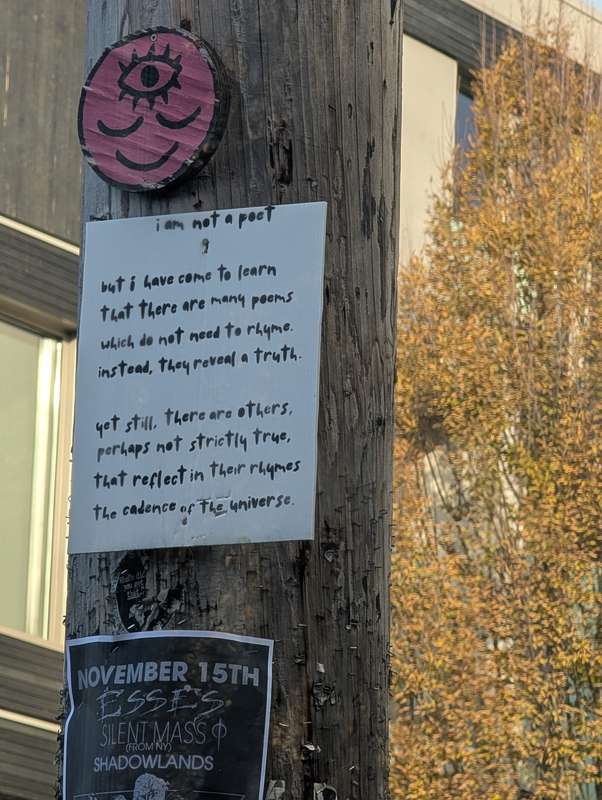
This one started with something real, found rather than invented: handwritten street art in downtown Portland, a short poem musing that some poems tell the truth without rhyming, while others rhyme in ways that aren't strictly true, just to catch the cadence of the universe. I don't know if it was original to whoever made that sign or something they'd borrowed, but it moved me, and it felt like the pulse of the city. If anyone recognizes it and knows who made it, I'd genuinely like to hear from them. I'd like the chance to return the favor of the inspiration.

The whole song lives inside the paradox on that sign: the person insisting “I am not a poet” is the one telling the truest thing in the room, and the title itself is the hook precisely because it's a denial the song quietly disproves every time it repeats. I wanted this one sung as a private confession overheard, not a statement performed. Kept in a smoky, unhurried jazz-lounge register the entire way through rather than building to any kind of gospel climax, deepening instead of erupting. Amy's voice here is someone thinking out loud in real time, a step or two ahead of most people and sharing what she's figured out in case it helps, not lecturing, just quiet generosity. It felt like the right note to close the album on: everything Amy Davis says across this record (about grief, about her body, about being left out, about a daughter she'll never meet) comes from the same place this song names directly. Not polish. Just the willingness to say the true thing out loud, however she'd describe herself.

The handwritten street sign in downtown Portland that inspired this song. If you know who made it, please get in touch — I'd like to properly credit and thank them.
I am not a poet, just a woman with a pen at two fifteen, watching streetlights paint the walls with shadows that know more than me. But I've learned that truth don't need A degree in pretty words— Sometimes it just needs Someone brave enough to bleed. I am not a poet, But I know when something's real. I am not a poet, But I know the way things feel. Some truths rhyme without trying, Like heartbeats, like the rain— I am not a poet, I just know this kind of pain. Found a notebook in the subway, Filled with someone else's fears, And I recognized my handwriting Though I'd never been there, dear. We all scribble the same prayers On napkins, receipts, and skin— Calling ourselves amateurs While the universe breaks in. [repeat chorus] Maybe poets are just people Who admit they're listening To the cadence underneath it all— That rhythm we're all missing. I hear it in the dishwater, In the sighs between the words, In the silence after "sorry," In the songs that go unheard. So I'll keep my denials, Wear them like a cheap disguise, While I translate what the moon says To the puddles full of sky. Not a poet, just a witness To the verses that we live— Not a poet, just a woman With some truth she's got to give. I am not a poet, But I know when something's real. I am not a poet, But I carved these words from steel. The universe keeps humming Its rhythm through my veins— I am not a poet, Just someone who explains.